Let's talk about salaries in the nonprofit sector
I started my career in the nonprofit sector, working with a youth education organisation. To this day, it is one of my favourite jobs.
Over the last 20 years, I’ve supported nonprofit organisations and leaders to attract the right people to their teams.
From global NFPs and The Prince's Trust in London to Australian household names like Cancer Council, The Heart Foundation, Starlight, Variety, Redkite, World Animal Protection and Foodbank — it is an immense privilege to play a small part in the ‘people’ part of the mission of so many incredible organisations.
I’ve also worked with very small nonprofits with 3, 5 or 10 staff — teams which punch well above their weight despite limited resources.
Limited resources and responsible use of funds are a given in the NFP sector.
"We don’t work here for the money."
"I know I could earn more in another job, but it’s not about the money."
"I took a 40% pay cut when I moved here."
"We know the salary we’re offering isn’t competitive."
I've heard these statements many, many times. Despite the significant momentum the Pay What It Takes movement is making to dismantle misconceptions and advocate for adequate investment to effectively deliver services and create impact (including salaries), most people believe there is still a lot of work to be done.
Two decades of conversations is a bucketload of insights. Anecdotally, I know most people who work in the NFP sector are not driven by money. This is as true today as it was when I started out as a rookie recruiter in 2005.
Here’s what has changed, though:
A global financial crisis.
The rise of flexible, part time and remote work.
Low employee engagement.
Higher turnover and shorter tenure.
A global pandemic.
An endless marathon of change and uncertainty.
A cost of living crisis.
A conversation about reframing overhead.
NFP employers offering more competitive salaries.
Yes, you read the last point right.
Salaries in the NFP sector are more competitive than you might think.
I’m not referring to the salary packaging benefits NFP employees in Australia can access to boost their take home pay. I’m referring to the ethos of paying what it takes.
15+ years ago, almost every conversation I had with a NFP hiring manager involved managing expectations about the salary being below market and limiting our ability to attract the right talent.
Today, these conversations are less common. They still happen, but not every day or week.
Paying a competitive salary is critical to attracting the right talent.
Paying a competitive salary makes big hairy audacious goals and bold missions easier to achieve.
In our research for the NFP Talent Attraction Report, 34% of employers indicated that they struggle to offer competitive salaries. While budgets will always be a consideration, what’s really interesting is what we found when we compared salaries across sectors.
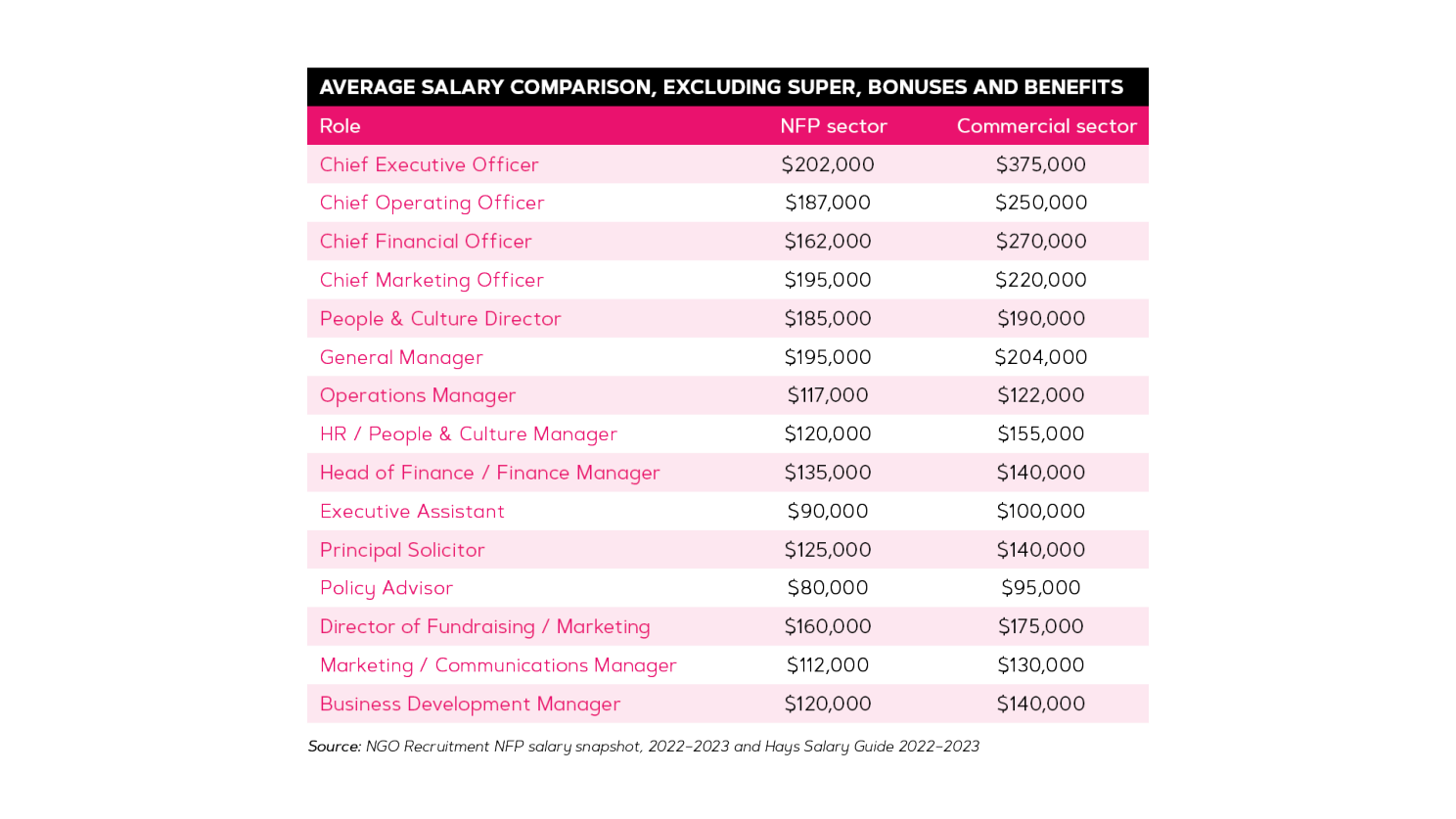
We took a look at average salaries across 15 jobs, comparing what people get paid in the NFP sector with what people get paid for the same role in the commercial sector — with small businesses with less than $50m turnover / less than 250 employees.
The results were a little surprising.
NFP employees get paid 22% less than their equivalent counterpart in the commercial sector.
The roles with the biggest variance between sectors are CEO and CFO.
Removing these salaries from this analysis, the variance in salary drops to 15%.
While 15% isn’t insignificant, it’s a much smaller gap than existed in the past.
If you're curious about fair market salaries or you have a question about something else in talent attraction, let’s have a chat.
If you need salary benchmarking or a remuneration review, I can help.